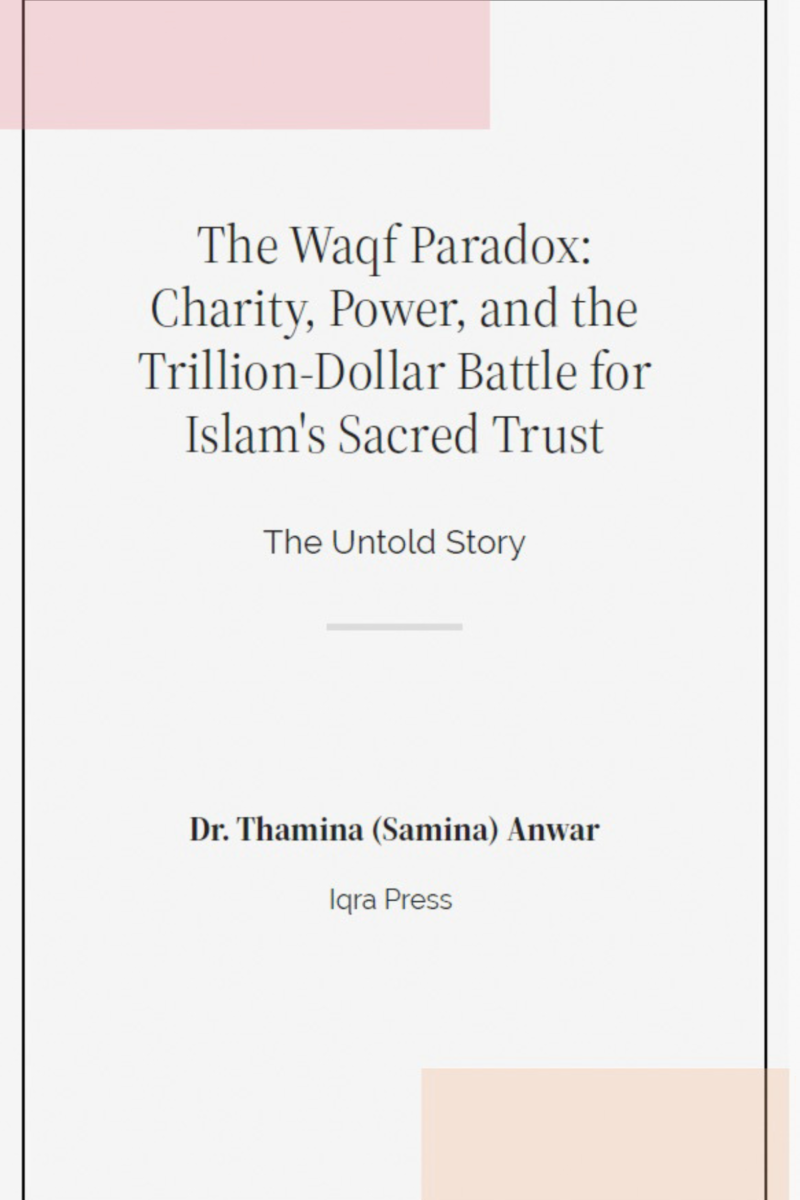
The Waqf Paradox- Charity, Power, and the Trillion-Dollar Battle for Islam’s Sacred Trust – The Untold Story
$19.99–$299.00Price range: $19.99 through $299.00
A trillion dollars in Islamic assets. Stolen, frozen, and forgotten. This is the story of how we lost it—and how we can reclaim it.
Waqf (Islamic endowment) once built hospitals, universities, and entire civilizations. From the Prophet’s (SAW) first date grove to the great libraries of Baghdad, waqf was the engine of Islamic society for over a millennium.
Today, over $1 trillion in waqf properties lie dormant, mismanaged, or illegally seized. Colonialism stripped waqf of its legal protections. Bureaucratic corruption drained its resources. And in 2025, a firestorm erupted in India over proposed amendments to the Waqf Act—exposing the deep political and legal battles that continue to rage over this sacred trust.
The Waqf Paradox traces this extraordinary journey—from the golden age of Islamic civilization, through the colonial dismantling of waqf institutions, into the heart of contemporary legal controversies, and finally to the cutting edge of fintech, blockchain, and smart contracts that promise to revolutionize Islamic social finance.
This is not just history. This is a battle for justice—and the time to act is now.
What You Will Learn
How the Prophet’s (SAW) first endowment launched a global empire
How waqf built the greatest institutions of the Islamic Golden Age
Why over $1 trillion in waqf assets remain frozen or stolen
The explosive truth behind the 2025 Indian Waqf Act controversy
The untold stories of guardians and trustees—heroes and villains
How blockchain, fintech, and AI are transforming waqf
Practical frameworks for communities to reclaim and revitalize their waqf assets
Who This Book Is For
History enthusiasts seeking the untold story of Islamic civilization
Community activists fighting for social justice and reform
Policymakers and legal scholars analyzing waqf law and reform
Islamic finance professionals exploring fintech and blockchain applications
Students and academics in Islamic history, law, economics, and development
Concerned Muslims who want to understand and revive this sacred trust
Non-Muslim readers seeking insight into one of Islam’s most powerful institutions
Waqf (Islamic endowment) stands at the intersection of all three.
It is ongoing charity that outlives its founder. It is beneficial knowledge preserved through institutions of learning. And it is a legacy that nourishes communities for centuries, serving as a spiritual bridge between this world and the next.
Yet today, the very institution that once built civilizations, funded hospitals, educated generations, and sustained entire communities lies in ruins. Trillions of dollars’ worth of waqf assets remain frozen, mismanaged, or stolen outright. The sacred trust (amanah) entrusted to Muslims by Allah (SWT) has been betrayed by neglect, colonialism, bureaucratic corruption, and—most painfully—by our own collective indifference.
This book is an attempt to understand how that happened. And more importantly, how we can fix it.
Why This Book Now
In 2025, a controversy erupted in India over proposed amendments to the Waqf Act. The debates were fierce, the accusations flew across political divides, and the Muslim community found itself once again defending the sanctity of its religious endowments. But amidst the noise, a deeper truth was obscured: the crisis of waqf is not a modern political invention—it is the culmination of centuries of decline, mismanagement, and loss.
The headlines will fade. The political battles will move on. But the waqf lands will remain—stolen, dormant, or underutilized—and the communities that depend on them will continue to suffer.
This book is not a political polemic. It is not a partisan manifesto. It is an attempt to tell the full story of waqf—from its glorious origins in the time of the Prophet Muhammad (SAW), through its golden age when it powered Islamic civilization, to its systematic dismantling under colonial rule, and finally to its fragile, contested present.
More importantly, it is a book about revival. It is about the extraordinary potential of waqf to address the pressing challenges of our time—poverty, inequality, healthcare, education, and climate change—if only we have the courage, knowledge, and faith to restore it to its proper place.
The Waqf Paradox
The title of this book, The Waqf Paradox, was chosen deliberately. Waqf is at once:
Charity and Power: It is an act of worship driven by compassion, yet it confers immense economic and political influence.
Sacred and Contested: It is protected by divine law, yet it has been subject to endless legal battles, expropriation, and abuse.
Eternal and Fragile: It is designed to last forever, yet its survival depends entirely on human integrity, governance, and vigilance.
Religious and Secular: It is rooted in Islamic jurisprudence, yet its success requires modern financial acumen, legal reform, and technological innovation.
Local and Global: Each waqf serves a specific community, yet collectively they form a vast, interconnected ecosystem capable of addressing global challenges.
Understanding this paradox—and navigating it effectively—is the key to reviving waqf for the 21st century.
Who This Book Is For
This book is written for a broad audience, and deliberately so.
For the concerned Muslim who has heard about waqf but never fully understood its history, significance, or current crisis—this book provides a comprehensive, accessible overview.
For the student of Islamic history and law—this book offers a detailed exploration of classical jurisprudence, historical case studies, and the evolution of waqf across different regions and eras.
For the activist and community leader—this book equips you with the knowledge and tools to advocate for waqf reform and to mobilize your community around this forgotten pillar of Islamic civilization.
For the policymaker and legal scholar—this book presents a clear analysis of the legal and regulatory challenges facing waqf today, along with proposals for meaningful reform.
For the entrepreneur and innovator—this book introduces the cutting-edge developments in Islamic fintech, blockchain, and smart contracts that are poised to revolutionize waqf management.
For the non-Muslim reader—this book offers a window into one of the most powerful yet misunderstood institutions in Islamic history, demonstrating its relevance to global development, social justice, and interfaith cooperation.
Whoever you are, wherever you come from, if you believe that sacred trusts should be honored, that charity should be effective, and that communities deserve better than neglect and corruption—then this book is for you.
The Journey Ahead
The structure of this book reflects the arc of waqf itself—rise, fall, and revival.
Part I: The Foundation takes you to the very beginning. You will walk through the date grove that the Prophet Muhammad (SAW) himself endowed, witnessing the birth of an institution that would eventually span continents and centuries. You will stand in the great hospitals of Damascus, the universities of Baghdad, and the public fountains of Istanbul, witnessing the extraordinary civilization that waqf built. And you will sit with the classical jurists, learning the immutable rules that made waqf both powerful and permanent.
Part II: The Collapse is a story of loss—profound, systemic, and devastating. You will trace the colonial dismantling of waqf institutions, the bureaucratic capture that drained their resources, and the corruption that eroded public trust. You will journey into the heart of the Indian subcontinent, where the Waqf Act controversies of 2025 are merely the latest chapter in a long history of legal and political battles. And you will meet the mutawallis—the guardians and trustees—whose stories of integrity and greed illuminate the human dimension of this crisis.
Part III: The Revival is a story of hope and innovation. You will explore how waqf can be revitalized for socioeconomic justice—providing affordable housing, healthcare, education, and sustainable development. You will enter the world of cash waqfs, crowdfunding, cryptocurrency, and blockchain, witnessing the fintech revolution that is transforming how waqf is funded and managed. And you will look to the future, exploring smart contracts, legal reform, and the evolving jurisprudence (al-‘urf) that will shape waqf for generations to come.
Finally, the Conclusion brings it all together, offering a clear vision for reclaiming the promise of waqf—a vision that is bold, practical, and rooted in both tradition and innovation.
A Note on Methodology and Sources
This book draws upon a wide range of sources:
Classical Islamic texts—the Quran, the Hadith, and the works of major jurists across the four Sunni schools of law, as well as Shia and other legal traditions where relevant.
Historical records—chronicles, endowment deeds, court records, and archival materials from across the Islamic world.
Modern scholarship—academic studies in Islamic law, history, economics, finance, and development.
Legal and policy documents—national waqf legislation, international reports, and contemporary legal debates.
Case studies and field research—interviews, site visits, and firsthand accounts from waqf managers, beneficiaries, and community members.
Wherever possible, the author has prioritized primary sources and contemporary scholarly consensus. Disagreements between jurists, historians, and scholars have been noted and presented fairly. The author’s aim is not to advocate for any particular school or approach, but to provide a balanced, comprehensive, and accessible account of this vast and complex subject.
That said, this book is not an academic monograph. It is written for a general audience, and the author has deliberately avoided overly technical language and dense footnoting. Key sources and further reading suggestions are provided in the bibliography and appendices for those who wish to explore further.
A Personal Reflection
The author has spent years studying waqf; not as an abstraction, but as a living, breathing institution with real consequences for real people. The author has walked through ancient waqf hospitals that now lie abandoned. She has spoken with people who remember when their local mosque and school were supported by endowment income, and who now watch those institutions struggle with empty coffers. She has stood on waqf land that was stolen, and has seen waqf properties that were lovingly restored and are once again serving their communities.
Every step of that journey deepened my conviction that waqf is not a relic of the past—it is a key to the future. In an era of staggering inequality, environmental crisis, and social fragmentation, the world desperately needs institutions that are:
Sustainable—designed to serve communities in perpetuity.
Ethical—grounded in divine principles of justice and compassion.
Community-centered—owned by no one and everyone, serving the public good.
Resilient—capable of weathering political and economic storms.
Waqf offers all of this and more. But it requires us to honor its sacred trust, to confront its history honestly, and to embrace its future with creativity and courage.
A Call to Action
This book is not intended to be read passively. It is a call to action—for every Muslim who cares about the legacy of their faith, for every citizen who believes in social justice, and for every human being who understands that the gifts we leave behind are the truest measure of our lives.
The Prophet Muhammad (SAW) said: “The best of people are those who are most beneficial to others.”
Waqf is the ultimate embodiment of that teaching—a tangible, lasting, and sacred mechanism for benefiting others long after we are gone.
However, waqf cannot revive itself. It requires you. Your understanding. Your advocacy. Your resources. Your integrity. Your innovation. Your faith.
The trillion-dollar battle for Islam’s sacred trust is not being fought in courtrooms and parliaments alone—it is being fought in the hearts and minds of every Muslim who chooses to care, to act, and to honor the legacy of those who came before.
Will you answer that call?
Acknowledgments
No book of this scope is the work of one person. The author is deeply grateful to the scholars, historians, jurists, and practitioners whose work has illuminated this field. She is equally grateful to the countless community members, waqf managers, and beneficiaries who shared their stories, their struggles, and their hopes with me over the years.
May this book be accepted as sadaqah jariyah—ongoing charity—for my parents, for my teachers, for my community, and for all those who read it and act upon its lessons.
And Allah knows best.
Additional information
Weight
N/A
Dimensions
N/A
Author
Dr. Thamina (Samina) Anwar
Audience
Educators, General Readers, Governments, Non-Profits, Policy Makers, Teachers, Unemployed, Young Adults
Format
Audiobook, Conference Proceedings, Digital Book, Hardcover, Institutional / University License, Journal, Paperback, Scholar Edition
Language
English
Publication Year
2026
Publisher
Iqra Press Charitable Trust
Reading Level
Intermediate
Series
Islamic Economy Series, Islamic social Entrepreneurship Series
Country / Region
New Zealand
License
Personal Use
Reviews
There are no reviews yet.
Only logged in customers who have purchased this product may leave a review.
Reviews
There are no reviews yet.