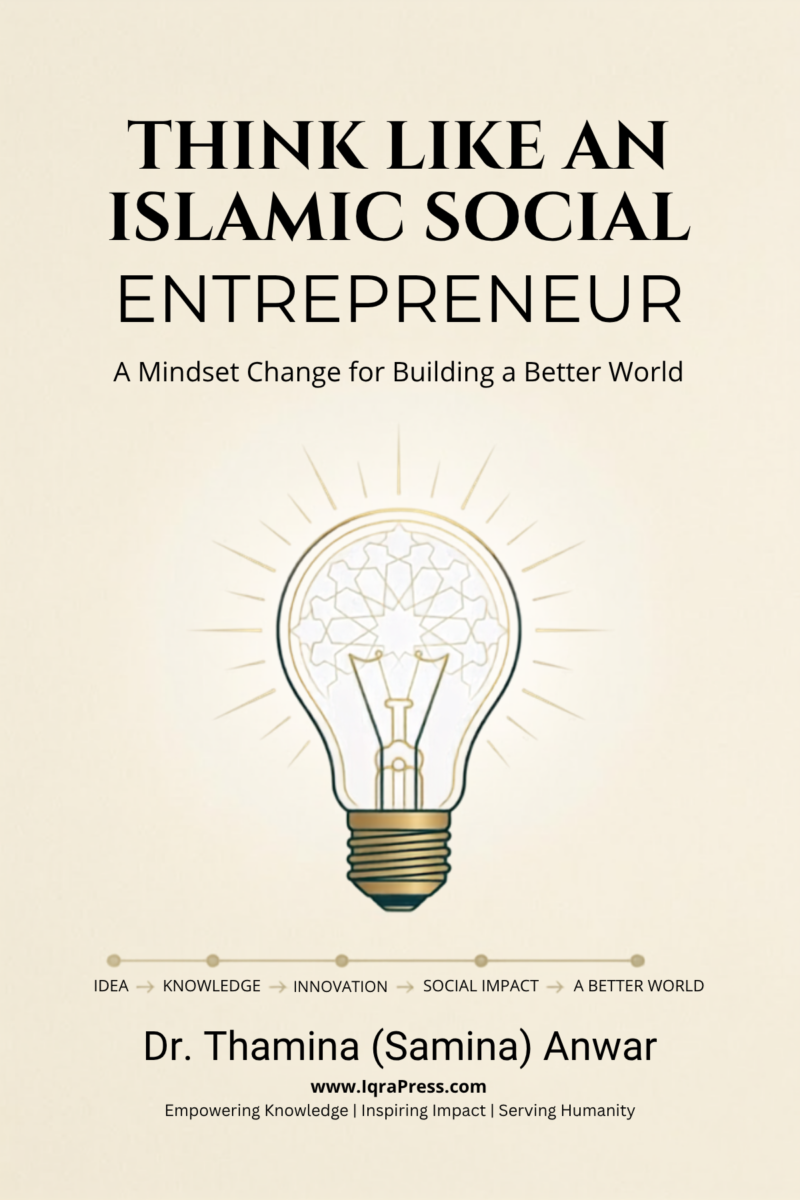
Think Like an Islamic Social Entrepreneur: A Mindset Change for Building a Better World
$19.99–$299.00Price range: $19.99 through $299.00
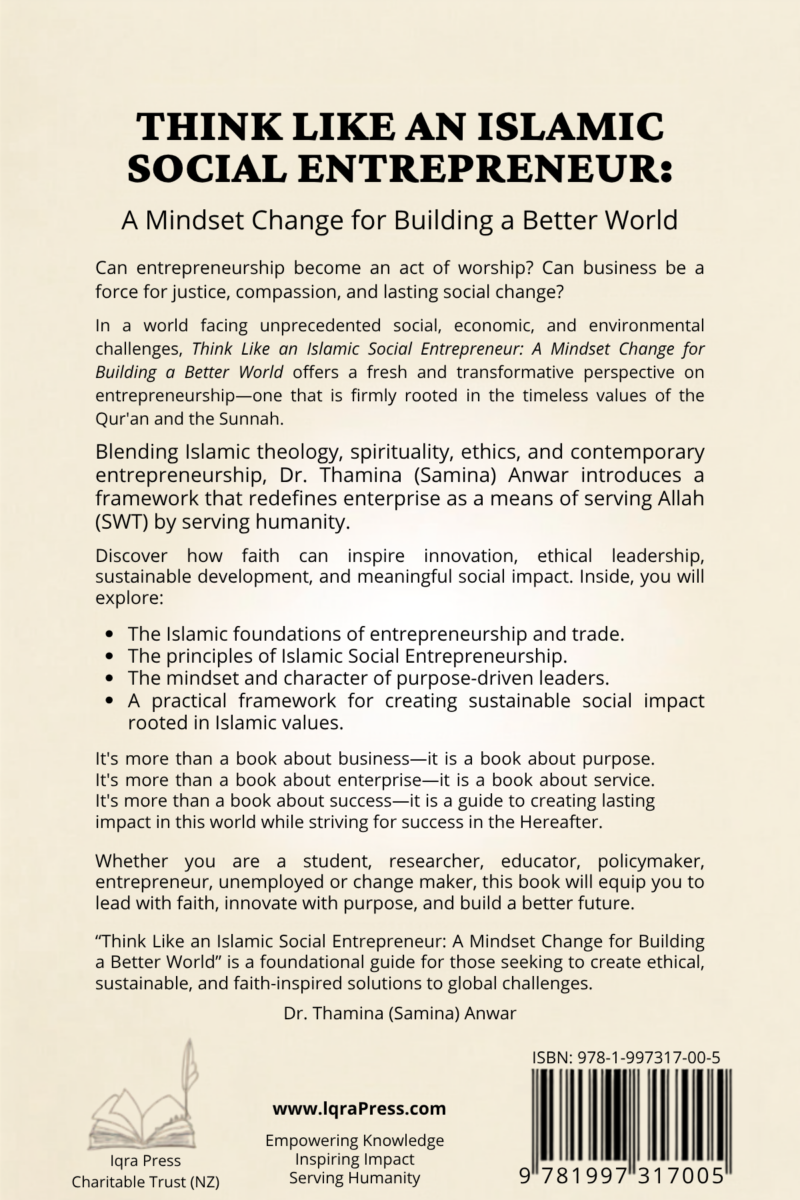
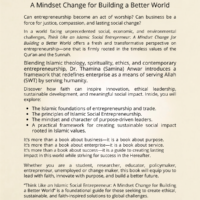
Think Like an Islamic Social Entrepreneur: A Mindset Change for Building a Better Worldexplores the transformative power of integrating Islamic values, entrepreneurial thinking, and social responsibility to address the complex challenges facing humanity. The book presents a new mindset for developing sustainable solutions inspired by faith, ethics, innovation, and compassion. It guides readers to become purpose-driven changemakers who use their knowledge, skills, and resources to create positive social impact and contribute towards a more just, inclusive, and sustainable world.
As a pioneering contribution to the field of Islamic Social Entrepreneurship, this book redefines entrepreneurship through the lens of Islamic values, bringing together faith, ethical leadership, innovation, and social responsibility into a comprehensive framework for sustainable development and transformative impact.
A foundational guide for individuals, organisations, and communities seeking to create ethical, sustainable, and faith-inspired solutions to global challenges, Think Like an Islamic Social Entrepreneur inspires a new generation of changemakers committed to building a better world.
In a world facing unprecedented social, economic, and environmental challenges, can entrepreneurship become a force for justice, compassion, and lasting social change? Think Like an Islamic Social Entrepreneur presents a definitive and transformative answer.
This landmark work, by Dr. Thamina (Samina) Anwar, introduces a pioneering framework that redefines enterprise through the lens of Islamic values. It is not merely a book about business; it is a call to a new way of thinking—a mindset shift that integrates the timeless principles of the Qur’an and Sunnah with the dynamic spirit of innovation to build a better world.
Bridging Islamic theology, spirituality, ethics, and contemporary entrepreneurship, this foundational textbook provides a comprehensive model for creating sustainable social impact. It explains how faith can inspire innovation, ethical leadership, and service to humanity, ultimately guiding you to pursue success in this world while striving for the ultimate success in the Hereafter (Al-Falah).
2. Why Read This Book?
To Understand a Holistic Model of Success: Discover a vision of success that transcends profit margins, encompassing spiritual fulfillment, moral integrity, and social justice.
To Integrate Faith with Practice: Learn how core Islamic principles like Tawhid (Oneness), Taqwa (God-Consciousness), and Tawakkul (Reliance on Allah) can directly inform and elevate your entrepreneurial journey.
To Gain a Comprehensive Framework: Move beyond isolated concepts with the “Integrated Islamic Social Entrepreneurship Framework,” a structured guide that unites spiritual, social, economic, and entrepreneurial dimensions.
To Become a Purpose-Driven Leader: Cultivate the mindset, characteristics, and spiritual depth required to lead with justice (Adl), compassion (Rahmah), and unwavering integrity (Amanah).
To Drive Sustainable Social Impact: Learn how to build innovative, ethically governed, and financially sustainable enterprises that empower communities and contribute to the Sustainable Development Goals (SDGs).
3. Key Topics Covered
The Islamic Foundations of Trade and Commerce (Prohibition of Riba, Fiqh al-Muʿāmalāt).
Entrepreneurship from an Islamic Perspective: The Entrepreneur as a Moral Agent and Steward (Khalifah).
Defining and Positioning Islamic Social Entrepreneurship (ISE) and the Islamic Social Enterprise (ISE).
The Pillars of Social Impact: Poverty Alleviation, Community Development, Social Justice, and Sustainability.
Spiritual Foundations: Tawhid, Taqwa, Tawakkul, Maqasid al-Shariah, and Al-Falah.
The Profile of an Islamic Social Entrepreneur: Spiritual, Ethical, and Entrepreneurial Characteristics (including Vision, Innovation, Risk-Taking).
The Role of Knowledge (ʿIlm), Wisdom (Ḥikmah), and Mentorship (Murshid).
The Integrated Islamic Social Entrepreneurship Framework: A comprehensive model for practice.
Aligning ISE with the Sustainable Development Goals (SDGs).
4. Learning Outcomes
Upon completing this book, you will be able to:
Articulate the Islamic ethical and legal principles that govern commerce and social enterprise.
Define and distinguish Islamic Social Entrepreneurship from conventional models.
Explain the spiritual and ethical characteristics of a faith-driven entrepreneur.
Apply the principles of Maqasid al-Shariah to solve complex social and economic problems.
Develop a mindset that balances financial sustainability with social responsibility and spiritual accountability.
Identify opportunities for creating sustainable social impact through innovative, ethically governed ventures.
Evaluate your own leadership potential and commitment to serving humanity for the pleasure of Allah (SWT).
5. Who Should Read This Book?
This book is an essential resource for a diverse and forward-thinking audience:
Aspiring & Current Entrepreneurs: Seeking to build faith-driven, sustainable social enterprises.
Students & Researchers: In the fields of Islamic Studies, Entrepreneurship, Economics, Social Work, and Development.
Policy Makers & Development Practitioners: Looking for faith-based approaches to achieve the SDGs and reduce poverty.
Non-Profit & Community Leaders: Wanting to transition from charity to sustainable social impact models.
Scholars & Educators: Who require a foundational textbook for courses on Islamic social finance, business ethics, and social entrepreneurship.
Anyone Seeking a Purposeful Life: Individuals who wish to integrate their professional work with their spiritual and moral values to contribute positively to the world.
6. Table of Contents
Part I: Foundations of Trade and Entrepreneurship in Islam
Chapter 1: Trade and Commerce in Islam
Chapter 2: Entrepreneurship from an Islamic Perspective
Part II: Understanding Islamic Social Entrepreneurship
Chapter 3: Islamic Social Entrepreneurship
Chapter 4: Islamic Social Enterprise
Chapter 5: Social Impact and Sustainable Development
Part III: Islamic Spiritual Foundations
Chapter 6: Islamic Spirituality and Entrepreneurship
Chapter 7: Tawhid: The Unifying Principle of Islamic Enterprise
Chapter 8: Taqwa: The Consciousness That Transforms Enterprise
Chapter 9: Tawakkul: Reliance, Risk, and Resilience in Enterprise
Chapter 10: Maqasid al-Shariah
Chapter 11: Al-Falah (The Ultimate Success)
Part IV: The Islamic Social Entrepreneur
Chapter 12: Defining the Islamic Social Entrepreneur
Chapter 13: Spiritual Characteristics: The Forging of the Believer’s Soul
Chapter 14: Ethical Characteristics
Chapter 15: Islamic Social Entrepreneurial Characteristics
Chapter 16: Knowledge, Wisdom, and Mentorship
Part V: The Islamic Social Entrepreneurship Framework
Chapter 17: The Integrated Islamic Social Entrepreneurship Framework
Chapter 18: Conclusion: The Future of Islamic Social Entrepreneurship
7. About the Author
Dr. Thamina (Samina) Anwar is an internationally recognised scholar, consultant, Islamic social entrepreneur, educator, International speaker and author. With a distinguished multidisciplinary background spanning engineering, information technology, management, governance, leadership, waqf and charitable trust establishment and management, business strategy, Islamic finance, and education, she brings together decades of academic achievement and international professional experience. Throughout her career, she has worked and collaborated across multiple countries, contributing to research, education, governance, and strategic development in both the public and private sectors.
She holds a PhD from the University of KwaZulu-Natal (South Africa), an MBA from Cranfield University (United Kingdom), and the Chartered Islamic Finance Professional (CIFP) master’s qualification from INCEIF (Malaysia).
Dr. Anwar earned her Bachelor of Engineering (Honours) in Electronic Engineering from the University of London, followed by a Master of Science (MSc) in Telecommunications and Real-Time Electronics from the University of Bradford (United Kingdom), where she specialized in Satellite Communications.
She also holds a Postgraduate Diploma in Teaching from the University of Auckland (New Zealand), specialising in curriculum development and educational management.
Dr. Anwar’s pioneering work focuses on integrating the timeless guidance of the Qur’an and the Sunnah with contemporary business strategy to develop innovative, Sharīʿah-informed models for entrepreneurship, sustainable development, socio-economic justice, and community empowerment. Her research and practice encompass Islamic Social Entrepreneurship, waqf revitalization, the halal economy, ethical leadership, Islamic governance, and social innovation.
She is the founder of several organizations dedicated to advancing the global halal ecosystem, ethical enterprise, Islamic education, and sustainable socio-economic development. As an international keynote speaker, consultant, board advisor, and thought leader, her expertise in halal governance, waqf revitalization, and Islamic Social Entrepreneurship continues to influence policy, research, and practice across the globe.
Driven by a vision to contribute to the revival of Islamic civilization, Dr. Anwar is committed to promoting ethical leadership, knowledge, innovation, and transformative enterprise rooted in the enduring principles of the Qur’an and the Sunnah.
Additional information
Weight
N/A
Dimensions
N/A
Author
Dr. Thamina (Samina) Anwar
Audience
Educators, General Readers, Governments, Non-Profits, Policy Makers, Teachers, Unemployed, Young Adults
Format
Audiobook, Conference Proceedings, Digital Book, Hardcover, Institutional / University License, Journal, Paperback, Scholar Edition
Language
English
Publication Year
2026
Publisher
Iqra Press Charitable Trust
Reading Level
Intermediate
Series
Islamic Economy Series, Islamic social Entrepreneurship Series
Country / Region
New Zealand
License
Personal Use
4 reviews for Think Like an Islamic Social Entrepreneur: A Mindset Change for Building a Better World
S Anwar –
Professor Emeritus Datuk Dr Syed Othman Alhabshi
Retired Deputy President (Academic) and
International Centre of Education In Islamic Finance (INCEIF), Kuala Lumpur.
Foreword
In the name of Allah, the Most Compassionate, the Most Merciful
“And cooperate in righteousness and piety” (Quran 5:2)
The world today stands at a very critical crossroads. We are confronted by ever
widening inequalities, environmental degradation, economic uncertainties and
social fragmentation that certainly demand more than conventional solutions.
Although technological advancement and economic growth have brought
considerable progress, they have not always translated into greater justice,
compassion or human well-being. Indeed, if left unchecked, the problems not
only persist but degrade further. Hence there is a need for a new generation of
leaders and entrepreneurs who are inspired not only by innovation and
enterprise but more importantly by purpose, ethics and a sincere and strong
commitment to serving humanity.
It is within this context that Dr Thaminah Anwar’s Think Like an Islamic Social
Entrpreneur: A Mindset Change makes a timely and significant contribution.
Rather than viewing entrepreneurship solely as an economic activity or even as
a means of amassing personal wealth, this book encourages readers to view
entrepreneurship through the lens of Islam which is a comprehensive world
view where business, spirituality, ethics, and social responsibility are
inseparably integrated. This reminds us that Islam never regarded commerce
merely as a means of financial gain. Instead, wealth is viewed as a trust
(amanah), entrepreneurship as a form of worship (ibadah) when conducted
sincerely and ethically, and success is measured not only by worldly
achievement but more so ultimately by the attainment of the pleasure of Allah
(SWT) and al-falah.
One of the greatest strengths of this book is its emphasis of mindset. Before
institutions can be established, there is need to develop individuals who have
transformed the way they think. Sustainable social change begins with hearts
guided by Tawhid, minds shaped by Taqwa, and actions motivated by Ihsan.
This book rightly argues that Islamic Social Entrepreneur is not simply by
establishing institutions with social objectives; rather it begins with nurturing
individuals whose values, intentions, and decisions emulate the higher
objectives of the Shariah and whose entrepreneurial efforts become vehicles
for mercy, justice and human progress.
Drawing upon the Qu’ran, the Sunnah of the Prophet Muhammad (SAW),
classical Islamic principles and contemporary scholarship, Dr Thaminah
presents a very thoughtful and integrated framework that bridges faith and
practice. Hence, the book successfully brings together entrepreneurship, social
practices, leadership, ethics Islamic economics and sustainable development
into a coherent body of knowledge that is both academically rigorous and
practically relevant.
More importantly, this work is beyond theory. It challenges readers to view
problems as opportunities, to make social problems as avenues for service and
to recognize every entrepreneurial endeavor as a means as fulfilling one’s
responsibility as a vicegerent (khalifah).
I believe that this book will be of immense value to students, educators,
researchers, policymakers, entrepreneurs, social innovators and leaders across
the Muslim world and beyond. Its insights are equally relevant to anyone
seeking to build enterprises that balance economic viability with social justice,
environmental stewardship and ethical responsibility.
As nations strive to achieve sustainable development and inclusive prosperity,
Islamic Social Entrepreneurship offers a distinctive and unique contribution
rooted in timeless divine guidance. It reminds us that meaningful development
is not measured solely by material wealth but the well-being of the people, the
strength of communities, the preservation of creation, and the cultivation of
moral excellence.
I sincerely commend Dr Thaminah Anwar for her vision, scholarship and
dedication in producing this very important piece of work. I earnestly hope
that this book and the nest one will stimulate further research, inspire
meaningful dialogue and most importantly encourage a new generation of
Islamic social entrepreneurs who seek to develop society through knowledge,
integrity, innovation, compassion, and unwavering faith in Allah (SWT). Indeed
she has already completed another book to train individuals to be an Islamic
Social Entrepreneur.
May Allah (SWT) bless this endeavor, accept it as a beneficial contribution and
make it a source of lasting benefit for individuals, communities and future
generations. May He grant all who read this book the wisdom to translate its
principles into actions that bring about justice, mercy and prosperity in this
world and everlasting success in the hereafter.
And Allah knows best (Wallahu A’lam)
7 th July 2026
S Anwar –
Daud Vicary Abdullah,
Managing Director DVA Consulting amd former PCEO at INCEIF and
Global Leader for Islamic Finance at Deloitte
Foreword
Dr. Anwar has produced a book that is not only comprehensive in its approach but is also a clear demonstration of how the dots that are entrepreneurship. commerce and social responsibility may be joined up effectively.
5th July 2026
S Anwar –
Azah Atikah Anwar Batcha
Researcher in Islamic Economic Thought
Foreword
It is both a pleasure and a privilege to write the foreword to this book authored by Dr. Thamina Anwar, whom I first came to know during my time pursuing my professional qualifications in Islamic finance at INCEIF. I was always struck by her perseverance, kindness, professionalism and commitment to advancing knowledge in areas that have the potential to benefit society. Over the years, she has continued to establish herself as a dedicated researcher and consultant, contributing meaningfully to the growing discourse on Islamic entrepreneurship and social development. I praise Dr. Thamina for her dedication and perseverance in producing this valuable contribution.
This book reinforces the understanding that economics and entrepreneurship cannot be separated from questions of values, ethics, and principles since sustainable prosperity is ultimately measured not only by material achievement but also by the extent to which economic activities promote justice, trustworthiness, compassion, and the common good. In this respect, Islamic social entrepreneurship represents more than a business model; it reflects a philosophy of responsible human conduct grounded in accountability before Allah SWT.
Since knowledge has always occupied a central place in Islamic civilization, the pursuit, preservation, and dissemination of beneficial knowledge are among the noblest forms of contribution to society. Hence, it is my hope that this work will inspire readers to rethink the purpose of entrepreneurship, appreciate its ethical and social dimensions, and recognise its potential to become a means of serving both our Creator and humanity.
May the goodness contained in this book encourage greater commitment to ethical, responsible, and impactful entrepreneurship. I pray that Allah SWT blesses the efforts of the author, grants acceptance of this work, and allows it to become a lasting source of benefit for all who read it.
13th July 2026
S Anwar –
Nicole El Hekma
Islamic Business Strategist, Executive Coach, Speaker and Author
Foreword
What about this: Every now and then you meet someone whose life’s work is so consistent that it becomes impossible to separate the person from the purpose.
Dr Thamina Anwar is one of those people.
Over the years that I have come to know Thamina, I have watched her return, time and again, to the same central question: How do we build a better world through Islam?
Not through slogans.
Not through criticism.
Not through simply pointing out what is wrong.
But by building institutions, developing leaders, creating opportunities and equipping people to serve their communities with excellence.
That question has shaped her research, her teaching, her consulting, her entrepreneurship and now this remarkable book.
Although our own work takes different forms, I have always felt that we are walking the same road, and only approaching it from slightly different directions.
My own work focuses on helping people align their hearts, intentions and purpose with Allah before they step into leadership, careers or business. Thamina’s work begins where mine naturally flows, showing what becomes possible when that inner transformation is expressed through enterprise, service and social impact.
Together they form a beautiful picture.
Because Islam has never separated faith from work.
Business from worship.
Success from service.
Or wealth from responsibility.
One of the things I admire most about Thamina is that she refuses to accept the false choice between commercial excellence and social good. In her world, and indeed in the Islamic worldview, they are not opposing forces. Business becomes a vehicle through which justice, compassion, stewardship and human flourishing can be realised.
That vision runs through every page of this book.
This is not simply another book about entrepreneurship.
Nor is it merely an academic text, although readers will immediately recognise the extraordinary scholarship that underpins it. It is evident from the breadth and depth of the work that this is the product of years of research, careful thought and an unwavering commitment to integrating classical Islamic scholarship with contemporary challenges.
More importantly, however, this is a book of hope.
It reminds us that Muslims have never been called simply to participate in society, but to contribute meaningfully to it.
To build.
To innovate.
To solve problems.
To uplift communities.
To leave the world better than we found it.
In an age where entrepreneurship is often defined by personal wealth, influence or disruption, Thamina offers something richer: a vision in which enterprise becomes an expression of amanah, leadership becomes an act of service, and success is measured not only by what we accumulate, but by what we contribute for the sake of Allah.
That is a desperately needed conversation.
Whether you are a student, entrepreneur, policymaker, academic, business owner or simply someone searching for a more purposeful way to serve, this book will challenge you to think differently.
More importantly, it will challenge you to think Islamically.
As I read these pages, I found myself continually returning to one thought.
Imagine if more of us approached our careers, businesses and organisations with this mindset.
Imagine if our greatest ambition was not simply to build successful enterprises, but to build enterprises worthy of standing before Allah.
That is the invitation Thamina extends to every reader.
And having had the privilege of witnessing the passion, integrity and dedication she has poured into this work, I cannot think of anyone better placed to extend that invitation.
May Allah accept this effort as ongoing charity, place immense barakah in it, and allow it to inspire a new generation of leaders who measure success not only by what they achieve in this world, but by what they leave behind for the next.
27th July 2026
Only logged in customers who have purchased this product may leave a review.





S Anwar –
Professor Emeritus Datuk Dr Syed Othman Alhabshi
Retired Deputy President (Academic) and
International Centre of Education In Islamic Finance (INCEIF), Kuala Lumpur.
Foreword
In the name of Allah, the Most Compassionate, the Most Merciful
“And cooperate in righteousness and piety” (Quran 5:2)
The world today stands at a very critical crossroads. We are confronted by ever
widening inequalities, environmental degradation, economic uncertainties and
social fragmentation that certainly demand more than conventional solutions.
Although technological advancement and economic growth have brought
considerable progress, they have not always translated into greater justice,
compassion or human well-being. Indeed, if left unchecked, the problems not
only persist but degrade further. Hence there is a need for a new generation of
leaders and entrepreneurs who are inspired not only by innovation and
enterprise but more importantly by purpose, ethics and a sincere and strong
commitment to serving humanity.
It is within this context that Dr Thaminah Anwar’s Think Like an Islamic Social
Entrpreneur: A Mindset Change makes a timely and significant contribution.
Rather than viewing entrepreneurship solely as an economic activity or even as
a means of amassing personal wealth, this book encourages readers to view
entrepreneurship through the lens of Islam which is a comprehensive world
view where business, spirituality, ethics, and social responsibility are
inseparably integrated. This reminds us that Islam never regarded commerce
merely as a means of financial gain. Instead, wealth is viewed as a trust
(amanah), entrepreneurship as a form of worship (ibadah) when conducted
sincerely and ethically, and success is measured not only by worldly
achievement but more so ultimately by the attainment of the pleasure of Allah
(SWT) and al-falah.
One of the greatest strengths of this book is its emphasis of mindset. Before
institutions can be established, there is need to develop individuals who have
transformed the way they think. Sustainable social change begins with hearts
guided by Tawhid, minds shaped by Taqwa, and actions motivated by Ihsan.
This book rightly argues that Islamic Social Entrepreneur is not simply by
establishing institutions with social objectives; rather it begins with nurturing
individuals whose values, intentions, and decisions emulate the higher
objectives of the Shariah and whose entrepreneurial efforts become vehicles
for mercy, justice and human progress.
Drawing upon the Qu’ran, the Sunnah of the Prophet Muhammad (SAW),
classical Islamic principles and contemporary scholarship, Dr Thaminah
presents a very thoughtful and integrated framework that bridges faith and
practice. Hence, the book successfully brings together entrepreneurship, social
practices, leadership, ethics Islamic economics and sustainable development
into a coherent body of knowledge that is both academically rigorous and
practically relevant.
More importantly, this work is beyond theory. It challenges readers to view
problems as opportunities, to make social problems as avenues for service and
to recognize every entrepreneurial endeavor as a means as fulfilling one’s
responsibility as a vicegerent (khalifah).
I believe that this book will be of immense value to students, educators,
researchers, policymakers, entrepreneurs, social innovators and leaders across
the Muslim world and beyond. Its insights are equally relevant to anyone
seeking to build enterprises that balance economic viability with social justice,
environmental stewardship and ethical responsibility.
As nations strive to achieve sustainable development and inclusive prosperity,
Islamic Social Entrepreneurship offers a distinctive and unique contribution
rooted in timeless divine guidance. It reminds us that meaningful development
is not measured solely by material wealth but the well-being of the people, the
strength of communities, the preservation of creation, and the cultivation of
moral excellence.
I sincerely commend Dr Thaminah Anwar for her vision, scholarship and
dedication in producing this very important piece of work. I earnestly hope
that this book and the nest one will stimulate further research, inspire
meaningful dialogue and most importantly encourage a new generation of
Islamic social entrepreneurs who seek to develop society through knowledge,
integrity, innovation, compassion, and unwavering faith in Allah (SWT). Indeed
she has already completed another book to train individuals to be an Islamic
Social Entrepreneur.
May Allah (SWT) bless this endeavor, accept it as a beneficial contribution and
make it a source of lasting benefit for individuals, communities and future
generations. May He grant all who read this book the wisdom to translate its
principles into actions that bring about justice, mercy and prosperity in this
world and everlasting success in the hereafter.
And Allah knows best (Wallahu A’lam)
7 th July 2026
S Anwar –
Daud Vicary Abdullah,
Managing Director DVA Consulting amd former PCEO at INCEIF and
Global Leader for Islamic Finance at Deloitte
Foreword
Dr. Anwar has produced a book that is not only comprehensive in its approach but is also a clear demonstration of how the dots that are entrepreneurship. commerce and social responsibility may be joined up effectively.
5th July 2026
S Anwar –
Azah Atikah Anwar Batcha
Researcher in Islamic Economic Thought
Foreword
It is both a pleasure and a privilege to write the foreword to this book authored by Dr. Thamina Anwar, whom I first came to know during my time pursuing my professional qualifications in Islamic finance at INCEIF. I was always struck by her perseverance, kindness, professionalism and commitment to advancing knowledge in areas that have the potential to benefit society. Over the years, she has continued to establish herself as a dedicated researcher and consultant, contributing meaningfully to the growing discourse on Islamic entrepreneurship and social development. I praise Dr. Thamina for her dedication and perseverance in producing this valuable contribution.
This book reinforces the understanding that economics and entrepreneurship cannot be separated from questions of values, ethics, and principles since sustainable prosperity is ultimately measured not only by material achievement but also by the extent to which economic activities promote justice, trustworthiness, compassion, and the common good. In this respect, Islamic social entrepreneurship represents more than a business model; it reflects a philosophy of responsible human conduct grounded in accountability before Allah SWT.
Since knowledge has always occupied a central place in Islamic civilization, the pursuit, preservation, and dissemination of beneficial knowledge are among the noblest forms of contribution to society. Hence, it is my hope that this work will inspire readers to rethink the purpose of entrepreneurship, appreciate its ethical and social dimensions, and recognise its potential to become a means of serving both our Creator and humanity.
May the goodness contained in this book encourage greater commitment to ethical, responsible, and impactful entrepreneurship. I pray that Allah SWT blesses the efforts of the author, grants acceptance of this work, and allows it to become a lasting source of benefit for all who read it.
13th July 2026
S Anwar –
Nicole El Hekma
Islamic Business Strategist, Executive Coach, Speaker and Author
Foreword
What about this: Every now and then you meet someone whose life’s work is so consistent that it becomes impossible to separate the person from the purpose.
Dr Thamina Anwar is one of those people.
Over the years that I have come to know Thamina, I have watched her return, time and again, to the same central question: How do we build a better world through Islam?
Not through slogans.
Not through criticism.
Not through simply pointing out what is wrong.
But by building institutions, developing leaders, creating opportunities and equipping people to serve their communities with excellence.
That question has shaped her research, her teaching, her consulting, her entrepreneurship and now this remarkable book.
Although our own work takes different forms, I have always felt that we are walking the same road, and only approaching it from slightly different directions.
My own work focuses on helping people align their hearts, intentions and purpose with Allah before they step into leadership, careers or business. Thamina’s work begins where mine naturally flows, showing what becomes possible when that inner transformation is expressed through enterprise, service and social impact.
Together they form a beautiful picture.
Because Islam has never separated faith from work.
Business from worship.
Success from service.
Or wealth from responsibility.
One of the things I admire most about Thamina is that she refuses to accept the false choice between commercial excellence and social good. In her world, and indeed in the Islamic worldview, they are not opposing forces. Business becomes a vehicle through which justice, compassion, stewardship and human flourishing can be realised.
That vision runs through every page of this book.
This is not simply another book about entrepreneurship.
Nor is it merely an academic text, although readers will immediately recognise the extraordinary scholarship that underpins it. It is evident from the breadth and depth of the work that this is the product of years of research, careful thought and an unwavering commitment to integrating classical Islamic scholarship with contemporary challenges.
More importantly, however, this is a book of hope.
It reminds us that Muslims have never been called simply to participate in society, but to contribute meaningfully to it.
To build.
To innovate.
To solve problems.
To uplift communities.
To leave the world better than we found it.
In an age where entrepreneurship is often defined by personal wealth, influence or disruption, Thamina offers something richer: a vision in which enterprise becomes an expression of amanah, leadership becomes an act of service, and success is measured not only by what we accumulate, but by what we contribute for the sake of Allah.
That is a desperately needed conversation.
Whether you are a student, entrepreneur, policymaker, academic, business owner or simply someone searching for a more purposeful way to serve, this book will challenge you to think differently.
More importantly, it will challenge you to think Islamically.
As I read these pages, I found myself continually returning to one thought.
Imagine if more of us approached our careers, businesses and organisations with this mindset.
Imagine if our greatest ambition was not simply to build successful enterprises, but to build enterprises worthy of standing before Allah.
That is the invitation Thamina extends to every reader.
And having had the privilege of witnessing the passion, integrity and dedication she has poured into this work, I cannot think of anyone better placed to extend that invitation.
May Allah accept this effort as ongoing charity, place immense barakah in it, and allow it to inspire a new generation of leaders who measure success not only by what they achieve in this world, but by what they leave behind for the next.
27th July 2026